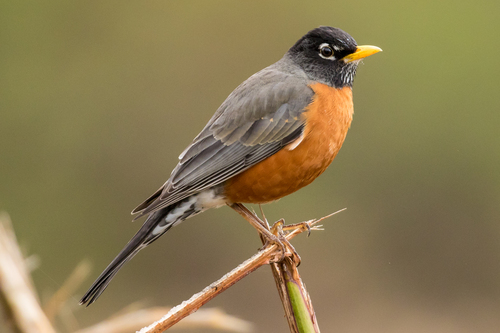
If you live almost anywhere in North America, the American Robin (Turdus migratorius) is probably already on your block. Slate-gray back, bright orange-red breast, and that busy little hop across the lawn that gives them away from a hundred feet.
What it looks like
About 25cm long, with a yellow beak and a thin white ring around the eye. Males are slightly brighter than females, but both share the same warm-orange chest. In flight, you'll see flashes of darker gray on the wings and a flick of white under the tail.
When and where
- Season: Year-round across most of the US, summer breeding in Canada and Alaska.
- Habitat: Lawns, parks, garden edges, suburban yards, school grounds. Anywhere there's open grass next to a few trees.
- Best time: Right after sunrise, especially on a damp morning when worms are near the surface.
How they hunt
Robins listen for worms with their ear, not their eye, that's why they tilt their head sideways before stabbing into the grass. They also see ultraviolet light, so what looks like a plain green lawn to us is actually a patchwork of contrast to a robin.
Spot one this weekend
The American Robin is a Common species, the perfect starting card for any new field journal. Take your kid out around 7am, find the closest patch of grass, and watch for the head-tilt before the dive. Snap one and let your kid name it at dinner.