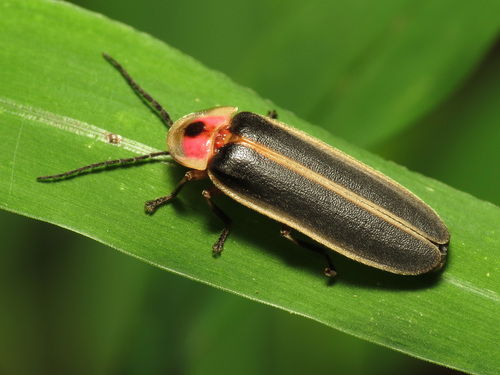
When summer dusk falls over a backyard or meadow east of the Rockies and tiny yellow-green lights start floating up from the grass, you are watching Common Eastern Fireflies (Photinus pyralis) start their evening show. They are the firefly most American kids meet first.
What it looks like
Adults are small flat beetles, about 1 to 1.5 cm long, with a brown body, a soft orange-pink shield behind the head marked with a black dot, and a pale yellow light organ on the underside of the last two abdominal segments. During the day they rest on tall grass and look like ordinary brown beetles. The famous lantern only shows when they fly at dusk, and only the adults light up, larvae glow too but live underground.
When and where
- Season: Mid-June through early August across the eastern and central US.
- Habitat: Backyards with long grass, meadow edges, woodland clearings, low-lying damp areas.
- Best time: The first 45 minutes after sunset, when the sky still holds a little blue.
The flash pattern is a signature
Each firefly species has its own flash code. Photinus pyralis males perform a slow J-shaped swoop: they dim, dive a few inches, then flash bright yellow-green as they rise. Females wait on the grass and answer with a single matching flash about two seconds later. Some predatory firefly species mimic these answers to lure males in and eat them, which is one of the wilder facts in insect biology. Firefly numbers have been falling in many states due to light pollution and lawn pesticides, so a dark backyard with some uncut grass is the best habitat you can offer.
Spot one this weekend
Common Eastern Fireflies are Common but only at the right hour. Turn off porch lights about 30 minutes after sunset and watch a patch of uncut grass or a meadow edge. Catching one in cupped hands for ten seconds, then letting it go, is a memory that lasts decades. Skip the jar with a lid.