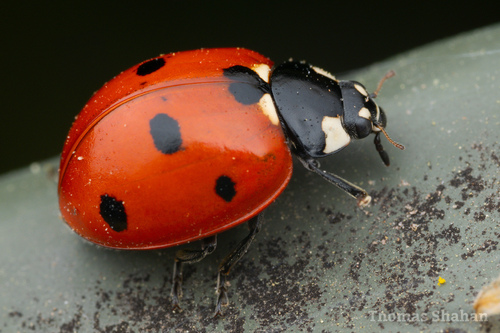
A bright red beetle with crisp black spots crawling on a garden leaf is most often a Seven-spotted Ladybug (Coccinella septempunctata). The pattern is the storybook ladybug, and the math is easy: one spot straddling the midline, three more on each side, for seven total.
What it looks like
About 7 to 8 mm long, slightly larger than the native ladybugs. The wing covers, called elytra, are deep crimson red with seven jet-black spots arranged in a fixed pattern. The head and pronotum (the shield behind the head) are black with two small white patches near the eyes. Legs and antennae are short and dark. When threatened, the beetle plays dead and oozes a yellow, foul-smelling fluid from its leg joints called reflex blood.
When and where
- Season: March through October across most of the US and southern Canada.
- Habitat: Gardens, hayfields, alfalfa, sunflower patches, weedy lot edges. Anywhere there are aphids.
- Best time: Warm, sunny mornings. They cluster on south-facing leaves.
A European who took over
Seven-spotted Ladybugs are originally from Europe and western Asia. They were repeatedly released across North America between 1956 and 1980 to control crop aphids, and the release worked too well. They became established, spread coast to coast, and now compete with smaller native ladybugs like the nine-spotted, which has become hard to find. The lesson here is that even pretty introductions can have hidden costs. A single Seven-spotted Ladybug still eats about 5,000 aphids in its lifetime, which is why farmers love it.
Spot one this weekend
Seven-spotted Ladybugs are Common. Check the underside of any aphid-covered plant in a garden or weedy lot. Roses, milkweed, and goldenrod are reliable. Once you find one, count the spots and confirm seven. Then look for a smaller ladybug nearby. If you find a native nine-spotted, that is a real wildlife win worth photographing.