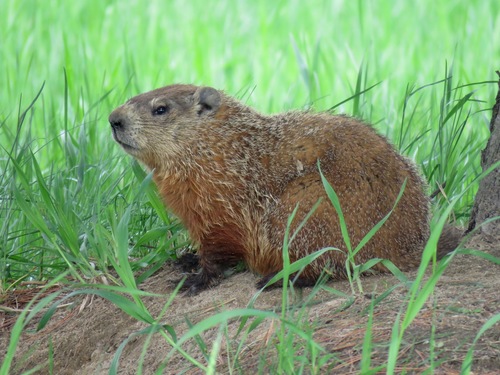
If you drive past a roadside field in the eastern US in late afternoon and see a chunky brown mammal sitting upright on its back legs, you are looking at a Woodchuck (Marmota monax). They are also called groundhogs, and they are one of the most visible large rodents in North America.
What it looks like
Adults are 40 to 65 cm long with a short bushy tail and weigh between 2 and 5 kg, about the size of a small house cat with a much rounder body. The fur is grizzled brown with a slightly grayer face. The legs are short and strong with dark curved claws built for digging. The most recognizable pose is the upright sentinel stance: standing on hind legs near a burrow entrance, front paws hanging loose, looking around for hawks and coyotes.
When and where
- Season: Active from March through October, true hibernators from November to February.
- Habitat: Meadow edges, hedgerows, suburban yards near fields, highway shoulders, golf course rough.
- Best time: Late afternoon, two hours before sunset, when they emerge to graze.
A burrow that becomes a neighborhood
A single woodchuck digs an extensive burrow system, often 8 to 15 meters of tunnels with multiple entrances, a separate sleeping chamber, and even a dedicated toilet chamber. After the woodchuck moves on, those burrows become homes for rabbits, skunks, foxes, opossums, and ground-nesting birds, which makes woodchucks important habitat engineers. In late summer they double their body fat to survive a full five-month hibernation, during which the heart slows from 80 beats per minute to about 5.
Spot one this weekend
Woodchucks are Common in the eastern half of the US. Drive slowly past any unmowed field edge late in the afternoon and scan for a brown lump near the grass line. If the lump suddenly stands up tall, you found one. Keep your distance, they will dive into a burrow if you walk closer than about 10 meters.