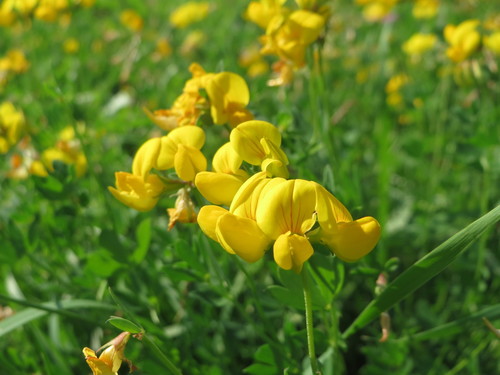
Those small, bright yellow flowers carpeting a sunny bank or lawn edge are Birdsfoot Trefoil (Lotus corniculatus). The fun part comes after the petals fade, when the slender seed pods spread out in a cluster that looks just like a tiny bird's clawed foot.
What it looks like
This low, sprawling plant rarely tops 30cm and often lies flat across the ground. The yellow pea-shaped flowers grow in small clusters of three to seven, sometimes flushed with orange or red so they look a little like scrambled eggs, a common nickname. Each leaf is made of five small leaflets, and after blooming the dark, narrow seed pods splay outward in the bird-foot shape that gives the plant its name.
When and where
- Season: Flowers from late spring through summer.
- Habitat: Roadsides, lawns, gravel banks, trail edges, and other open, sunny disturbed ground.
- Best time: Sunny summer middays, when the yellow flowers are fully open.
A pea that feeds the soil
Birdsfoot trefoil belongs to the legume family, the same group as peas and clover. Like its relatives, it partners with bacteria living in nodules on its roots that pull nitrogen from the air and turn it into plant food, enriching poor soil. That toughness is why it was widely planted along highways and pastures, and it is a favorite nectar stop for bees and a food plant for several butterfly caterpillars.
Spot one this weekend
Birdsfoot trefoil is Common along sunny paths and roadsides. Look for low mats of small yellow flowers, then hunt nearby for the spreading seed pods. Hold your hand up like a claw next to the pods and see how closely they match a real bird's foot.